Biomass Enzyme Supplier for Cellulosic Ethanol: Process Guide
Source biofuel enzymes for cellulosic ethanol with pH, temperature, dosing, QC, pilot validation, COA/TDS/SDS, and cost-in-use guidance.
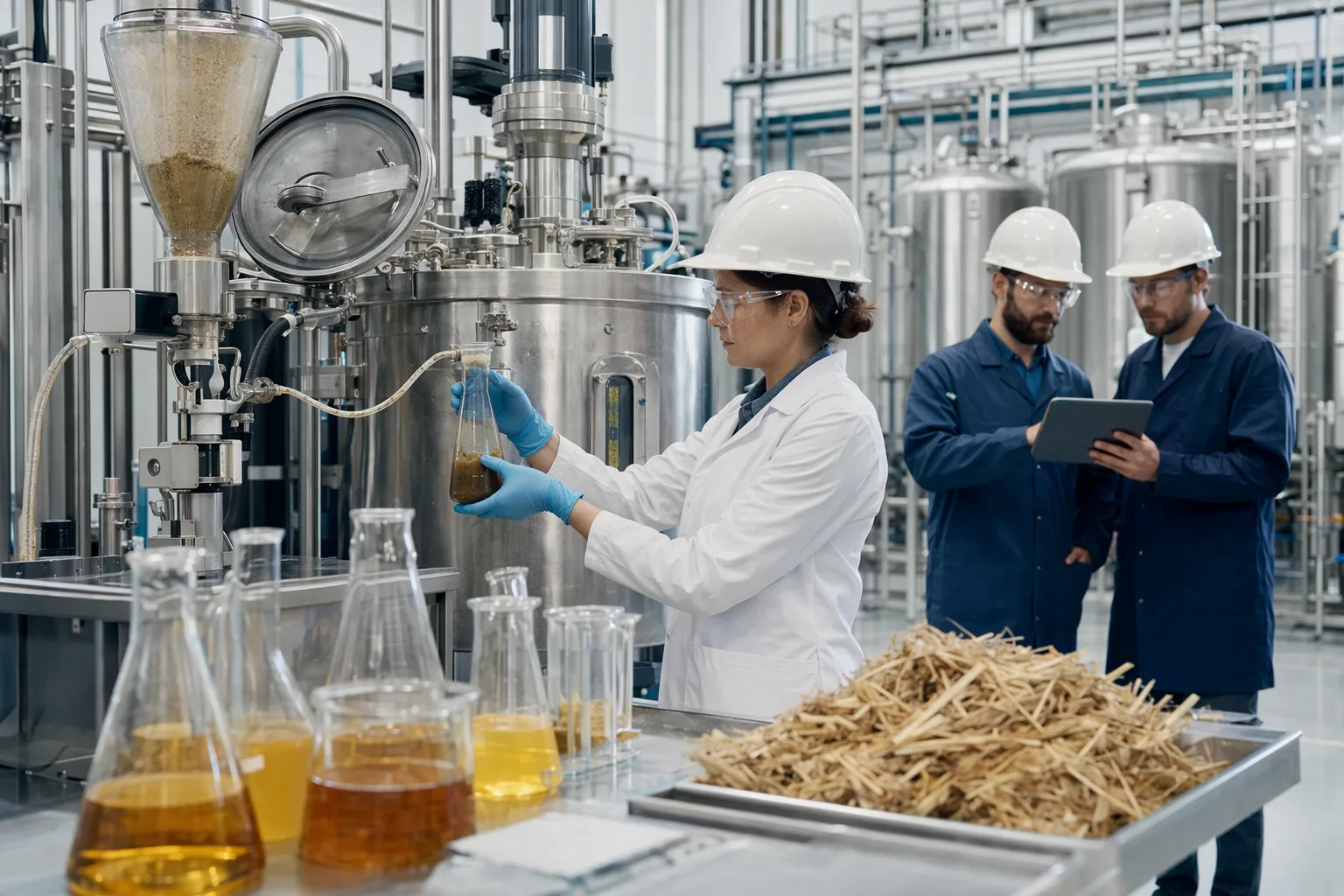
A practical procurement and process guide for selecting, validating, and scaling biomass enzyme systems for industrial cellulosic ethanol production.
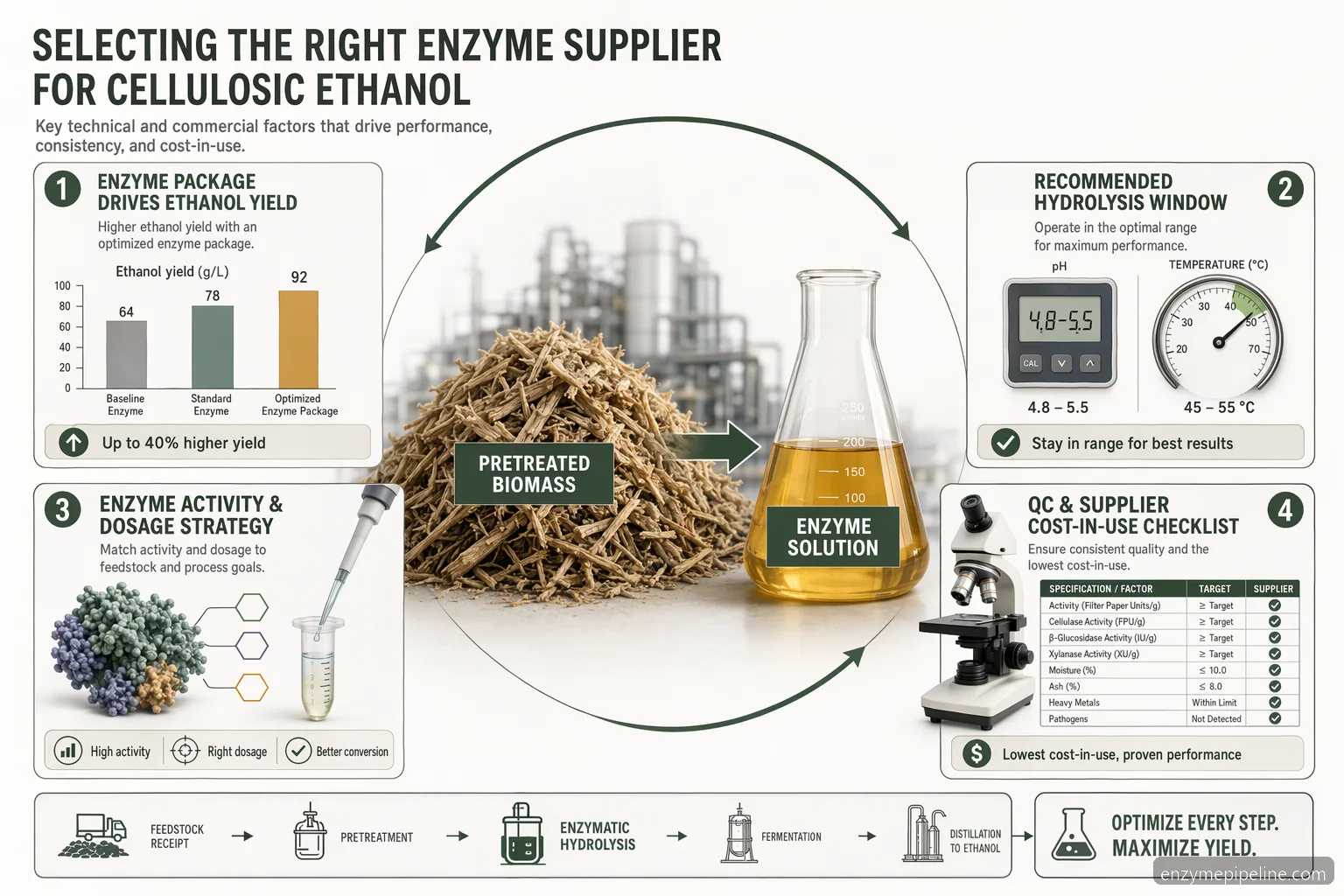
Why the Enzyme Package Defines Ethanol Yield
For a second-generation ethanol plant, the enzyme package must convert pretreated lignocellulosic biomass into fermentable C5 and C6 sugars at a yield that supports the production model. EnzymePipeline.com supports buyers comparing a biomass enzyme supplier for cellulosic ethanol by aligning feedstock, pretreatment chemistry, hydrolysis residence time, and downstream fermentation constraints before recommending a cellulase-heavy blend. Typical programs evaluate corn stover, wheat straw, bagasse, hardwood, or energy crops, each with different lignin carryover and inhibitor profiles. The right industrial biomass enzyme cellulosic ethanol solution normally combines cellulase, hemicellulase, beta-glucosidase, and accessory activities to reduce viscosity and limit cellobiose buildup. Procurement teams should request a current TDS, SDS, and COA for the supplied lot, then confirm enzyme activity and microbial limits against internal acceptance criteria before pilot use.
Best fit: pretreated lignocellulosic biomass streams • Key outputs: glucose, xylose, arabinose, reduced viscosity • Main risk: under-dosing, inhibition, or poor feedstock match
Recommended Process Window for Hydrolysis Trials
Most biomass enzyme for cellulosic ethanol screening starts with controlled bench hydrolysis before moving to pilot reactors. A common starting range is pH 4.8-5.5, temperature 45-55°C, 15-25% total solids, and 24-96 hours residence time, depending on pretreatment severity and target conversion. Agitation should be strong enough to keep solids suspended without causing excessive shear, foam, or heat buildup. For simultaneous saccharification and fermentation, the enzyme optimum must be balanced against yeast or bacterial tolerance, often requiring a lower temperature than enzyme-only hydrolysis. Measure dry matter, cellulose, hemicellulose, lignin, acetic acid, furans, and phenolics before enzyme addition. These data help a cellulosic ethanol enzyme supplier for cellulosic ethanol propose a starting dosage range and identify whether accessory enzymes may improve total sugar release.
Bench screen: small-volume hydrolysis with replicated controls • Pilot check: solids handling, mixing load, and contamination risk • Scale-up focus: sugar yield per tonne of dry biomass
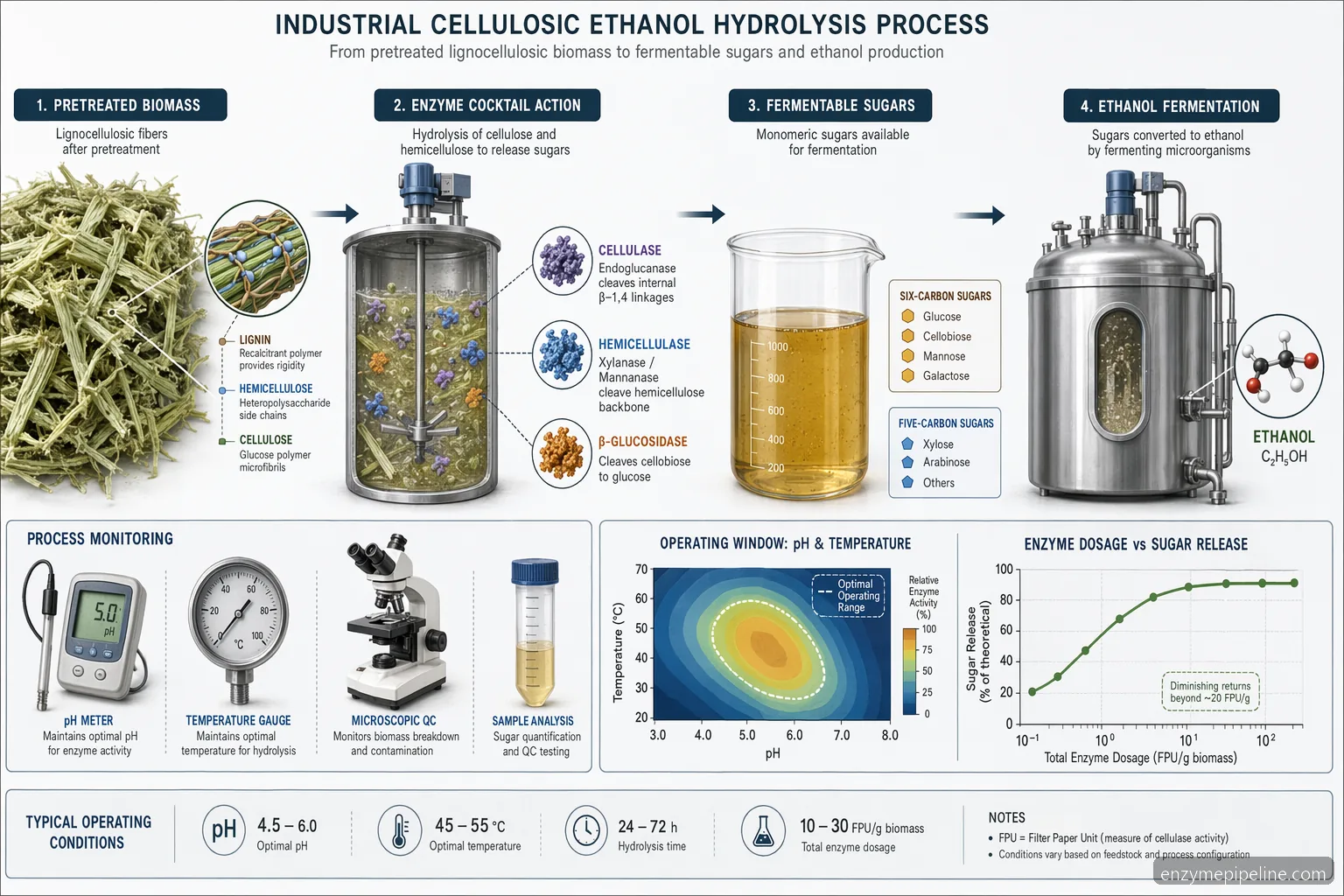
Enzyme Activities and Dosage Strategy
A practical industrial cellulosic ethanol enzyme cellulosic ethanol program begins with a dosage band, not a fixed recipe. Initial cellulase dosing may be screened around 5-25 FPU per gram of cellulose or an equivalent supplier-defined activity unit, then adjusted by conversion curve and economics. Beta-glucosidase helps convert cellobiose to glucose, while xylanase, arabinofuranosidase, mannanase, or lytic polysaccharide monooxygenase may improve access to cellulose in selected feedstocks. Dosage should be tested as a response surface with pH, temperature, solids loading, and residence time. The best result is rarely the highest sugar number alone; it is the best cost-in-use at the target ethanol yield. Ask the supplier to define activity units, assay method, storage stability, dilution guidance, and compatibility with antifoams, nutrients, pH adjusters, and fermentation organisms.
Start with supplier-recommended activity units • Optimize for cost per liter of ethanol, not only enzyme price • Check compatibility with fermentation and CIP practices
QC Checks Before Plant Trials
Before a candidate bioethanol enzyme enters a pilot campaign, quality control should confirm that the received material matches the technical package. Review the COA for activity, appearance, batch number, manufacture or retest date, and any listed microbial or contaminant limits. Compare the TDS to your target operating range for pH, temperature, shelf life, and recommended storage. Use the SDS to confirm PPE, spill response, ventilation, and transport handling. In the lab, run a reference substrate assay, viscosity observation, and hydrolysis control without enzyme. During pilot validation, track glucose, xylose, residual cellulose, ethanol titer, contamination indicators, and enzyme addition accuracy. If performance varies by lot, investigate storage temperature, dosing pump calibration, feedstock composition, and pretreatment consistency before changing the enzyme blend.
Required documents: COA, TDS, SDS • Core analytics: HPLC sugars, residual solids, ethanol titer • Operational checks: dosing accuracy, storage, and mixing
Supplier Qualification and Cost-in-Use
Selecting a biomass enzyme supplier for cellulosic ethanol is a technical and commercial decision. Unit price matters, but cost-in-use is driven by enzyme dosage, sugar conversion, residence time, solids loading, ethanol yield, logistics, and batch consistency. A qualified supplier should provide responsive technical support, transparent activity definitions, sample quantities for screening, pilot-scale supply planning, and documentation that your EHS and QA teams can review. Ask for recommended storage conditions, retest policy, packaging options, lead time, minimum order quantity, and change notification process. For tolling, licensing, or multi-site operations, verify whether the supplier can support repeatable specifications across locations. Avoid relying on broad marketing claims; instead, approve the enzyme through side-by-side trials using your biomass, pretreatment liquor, water quality, fermentation organism, and plant constraints.
Compare landed cost and performance at equal conversion targets • Require pilot validation before commercial commitment • Document acceptance criteria for each qualified lot
Related Biofuel Applications: Biogas and Biodiesel
Although this page focuses on cellulosic ethanol, many biofuel producers also evaluate enzyme programs across biogas and biodiesel assets. A cellulosic ethanol enzyme supplier for biogas may support hydrolysis of fibrous substrates before anaerobic digestion, where cellulase, hemicellulase, and protease blends can be screened for volatile solids reduction and methane potential. An industrial cellulosic ethanol enzyme biogas evaluation should use BMP testing, digestate monitoring, and site-specific economics rather than assumptions. For biodiesel, a cellulosic ethanol enzyme supplier for biodiesel is usually not supplying the same enzyme system; lipases for transesterification or esterification are evaluated under different pH, water, methanol, and temperature constraints. Industrial cellulosic ethanol enzyme biodiesel comparisons should therefore separate biomass hydrolysis enzymes from lipid-processing enzymes and qualify each application independently.
Biogas focus: hydrolysis support and methane potential • Biodiesel focus: lipase-driven lipid conversion • Ethanol focus: fermentable sugar release from biomass
Technical Buying Checklist
Buyer Questions
Start with your feedstock, pretreatment method, total solids target, hydrolysis time, fermentation format, and current sugar or ethanol yield. Then request a TDS, SDS, COA template, activity definitions, recommended dosage range, storage conditions, and sample size for screening. A serious supplier should help design a trial plan rather than quote only a price per kilogram.
A common starting point for cellulosic ethanol hydrolysis is pH 4.8-5.5 and 45-55°C, but the correct window depends on the enzyme blend, feedstock, pretreatment liquor, and fermentation organism. If you run simultaneous saccharification and fermentation, temperature may need to be reduced for organism viability. Always confirm the range in the supplier TDS before pilot work.
Dosage is usually optimized through bench and pilot trials using your actual biomass. Start with a supplier-recommended band, such as activity units equivalent to about 5-25 FPU per gram cellulose, then compare conversion, viscosity, residence time, and ethanol yield. The preferred dosage is the one that delivers the lowest cost-in-use at the required plant performance, not necessarily the highest sugar release.
Review the COA for batch identity, activity, appearance, date, and stated acceptance criteria. Confirm the TDS for pH, temperature, storage, and application guidance, and review the SDS for safe handling. Many plants also run an incoming reference assay, visual inspection, dosing-pump check, and small hydrolysis confirmation before releasing a lot for pilot or production use.
One supplier may support multiple biofuel applications, but the enzyme systems are different. Cellulosic ethanol typically uses cellulase and hemicellulase blends for sugar release. Biogas may use hydrolytic blends to improve substrate breakdown before anaerobic digestion. Biodiesel usually involves lipases for lipid conversion. Qualify each application separately with its own process conditions, documents, and performance metrics.
Related Search Themes
industrial biomass enzyme cellulosic ethanol, cellulosic ethanol enzyme supplier for cellulosic ethanol, cellulosic ethanol enzyme supplier for biogas, cellulosic ethanol enzyme supplier for biodiesel, biomass enzyme for cellulosic ethanol, industrial cellulosic ethanol enzyme cellulosic ethanol
Biofuel & Industrial Enzymes for Research & Industry
Need Biofuel & Industrial Enzymes for your lab or production process?
ISO 9001 certified · Food-grade & research-grade · Ships to 80+ countries
Frequently Asked Questions
What should I ask a biomass enzyme supplier for cellulosic ethanol first?
Start with your feedstock, pretreatment method, total solids target, hydrolysis time, fermentation format, and current sugar or ethanol yield. Then request a TDS, SDS, COA template, activity definitions, recommended dosage range, storage conditions, and sample size for screening. A serious supplier should help design a trial plan rather than quote only a price per kilogram.
What pH and temperature should we use for initial enzyme screening?
A common starting point for cellulosic ethanol hydrolysis is pH 4.8-5.5 and 45-55°C, but the correct window depends on the enzyme blend, feedstock, pretreatment liquor, and fermentation organism. If you run simultaneous saccharification and fermentation, temperature may need to be reduced for organism viability. Always confirm the range in the supplier TDS before pilot work.
How is enzyme dosage optimized for industrial cellulosic ethanol?
Dosage is usually optimized through bench and pilot trials using your actual biomass. Start with a supplier-recommended band, such as activity units equivalent to about 5-25 FPU per gram cellulose, then compare conversion, viscosity, residence time, and ethanol yield. The preferred dosage is the one that delivers the lowest cost-in-use at the required plant performance, not necessarily the highest sugar release.
Which QC checks are important before approving a biofuel enzyme lot?
Review the COA for batch identity, activity, appearance, date, and stated acceptance criteria. Confirm the TDS for pH, temperature, storage, and application guidance, and review the SDS for safe handling. Many plants also run an incoming reference assay, visual inspection, dosing-pump check, and small hydrolysis confirmation before releasing a lot for pilot or production use.
Can the same enzyme supplier support ethanol, biogas, and biodiesel?
One supplier may support multiple biofuel applications, but the enzyme systems are different. Cellulosic ethanol typically uses cellulase and hemicellulase blends for sugar release. Biogas may use hydrolytic blends to improve substrate breakdown before anaerobic digestion. Biodiesel usually involves lipases for lipid conversion. Qualify each application separately with its own process conditions, documents, and performance metrics.
Ready to source?
Turn This Guide Into a Supplier Brief Request a technical review and pilot-ready enzyme recommendation for your cellulosic ethanol process.
Contact Us to Contribute