Cellulosic Ethanol Plants: How to Buy and Qualify Enzyme Blends
For second-generation ethanol plants and the distributors who supply them: how to compare enzyme blends on your own biomass, check each lot, run a pilot that predicts plant results and request a quote.
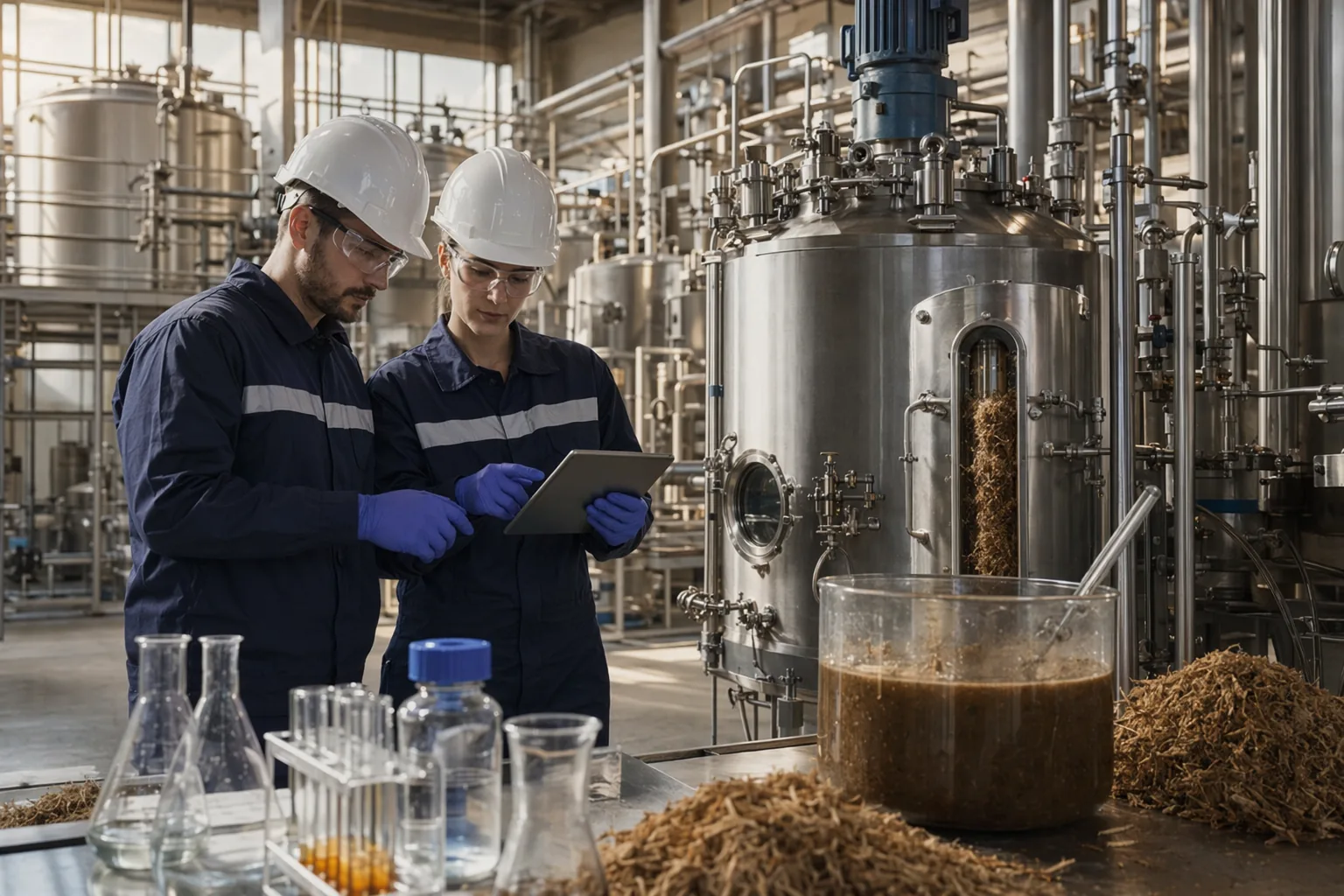
This guide is for ethanol producers, biomass processors, integrators and the distributors who supply them. It covers what to compare between enzyme blends, the lot checks to run before a plant trial, how to design a pilot that predicts plant results, and what to send when you request a quote.
To request a quote, send the product, the quantity and the destination through the inquiry form on our home page; feedstock and pretreatment details help us match the grade.
Why the enzyme blend decides cellulosic ethanol economics
Cellulosic ethanol depends on converting lignocellulosic biomass into fermentable C5 and C6 sugars after pretreatment. Commercial programs typically combine cellulases, hemicellulases, beta-glucosidase, and accessory enzymes such as xylanase, mannanase, arabinofuranosidase, or lytic polysaccharide monooxygenase depending on biomass type. Corn stover, wheat straw, bagasse, energy grasses, forestry residues, and municipal fiber fractions all present different cellulose crystallinity, hemicellulose structure, lignin interference, ash, and inhibitor profiles. A supplier should therefore support application testing rather than recommending a generic dose. Compare enzyme systems by sugar release per dry ton, hydrolysis time, viscosity reduction, fermentation compatibility, and stability in real process liquor. The best commercial decision is usually the formulation that delivers repeatable conversion at the lowest total cost-in-use, not simply the highest declared activity on a datasheet.
Assess feedstock composition before enzyme selection. • Compare performance in pretreated slurry, not only buffer assays. • Track glucose, xylose, viscosity, residual solids, and fermentation impact.
Blend components and what each one should earn
Cellulosic enzyme blends typically combine endoglucanase, exoglucanase or cellobiohydrolase, beta-glucosidase, xylanase and other hemicellulase activities to convert cellulose and hemicellulose into fermentable sugars. Accessory enzymes may improve performance on specific biomass by opening fiber structure, reducing cellobiose inhibition or improving xylan conversion. Before requesting quotes, define the conversion target and ask whether each candidate is a complete enzyme system or a component intended for custom blending; the two are dosed differently and should not be compared on unit price alone.
Cellulases drive cellulose conversion to glucose. • Hemicellulases support xylose and arabinose release from xylan-rich biomass. • Beta-glucosidase reduces cellobiose inhibition and supports glucose yield. • Accessory enzymes should be justified by a measured yield gain or cost reduction.
Process conditions to agree before trials
Most enzyme blends for cellulosic ethanol are applied after mechanical size reduction and thermochemical pretreatment. Our product range is specified for pH 4.0–6.5 and 45°C–65°C; the working window for your blend, solids loading, dosage and residence time should come from the product TDS and your own pilot data, not from a generic table. Agitation should prevent dead zones without excessive shear or energy demand. Dosage is best screened as a ladder on the activity basis the supplier defines, then judged by glucose release, conversion rate and cost-in-use. If simultaneous saccharification and fermentation is used, conditions must also suit the fermenting organism, which often means a compromise on temperature. Keep traceability for pH, temperature, dry solids, enzyme lot, addition timing and samples.
Agree the pH and temperature window with the TDS before the first run. • Screen dosage as a ladder, not a single point. • Check temperature in the bulk slurry, not only at the jacket; high-solids biomass develops gradients. • Validate compatibility with SSF or separate hydrolysis workflows.
How to run a pilot validation before scale-up
Pilot validation should replicate the intended plant process as closely as possible, including pretreatment liquor carryover, solids content, mixing intensity, heat-up profile, enzyme addition point, and residence time. Start with a statistically useful design of experiments that varies enzyme dosage, pH, temperature, solids loading, and residence time while holding biomass lots traceable. In every trial, measure released glucose and xylose by HPLC or validated rapid methods, and calculate conversion against compositional analysis rather than slurry volume alone. Include controls without enzyme and, where relevant, benchmark formulations already used by the site. Check whether higher sugar release also improves fermentation productivity, because inhibitors, osmotic load, and residual oligosaccharides may affect ethanol yield. Before procurement, request a technical report format that links enzyme lot, activity method, operating conditions, analytical results, and cost-in-use assumptions.
Use real pretreated biomass and process liquor. • Measure conversion against feedstock composition. • Include fermentation confirmation, not hydrolysis alone. • Document enzyme lot and analytical method for every run.
Quality documents and supplier qualification
Industrial buyers should qualify a biofuel enzyme supplier using both documentation and application performance. At minimum, request the Certificate of Analysis, Technical Data Sheet, Safety Data Sheet, recommended storage conditions, shelf-life statement, activity definition, and handling guidance for bulk or drum supply. The COA should identify batch number, key activity or potency measure, physical appearance, and release criteria used by the manufacturer. The TDS should describe application range, pH and temperature guidance, and any process limitations. The SDS should support site EHS review for storage, PPE, spill response, and transport classification. Supplier qualification may also include manufacturing change notification expectations, lead time, packaging options, allergen or sensitization handling guidance, and sample retention policy. Avoid relying on unverifiable claims; ask for application data, analytical methods, and pilot support relevant to cellulosic ethanol.
Request COA, TDS, SDS, activity method, and storage guidance. • Confirm lot traceability and change notification expectations. • Review EHS handling for enzyme dust, aerosols, or liquid spills. • Ask for application data generated under comparable conditions.
Incoming lot checks before a plant trial
Before a candidate enzyme enters a pilot campaign, confirm that the received material matches the technical package. Review the COA for activity, appearance, batch number, manufacture or retest date and any listed microbial or contaminant limits. Compare the TDS to your target operating range for pH, temperature, shelf life and recommended storage. Use the SDS to confirm PPE, spill response, ventilation and transport handling. In the lab, run a reference substrate assay, a viscosity observation and a hydrolysis control without enzyme. Because activity assay methods vary by supplier, do not compare unit values unless the assay conditions, substrate and calculation basis are stated. Retain a sample from each lot for troubleshooting and stability comparison.
Required documents: COA, TDS, SDS • Core analytics: HPLC sugars, residual solids, ethanol titer • Operational checks: dosing accuracy, storage temperature and mixing
When results vary: check the process before the enzyme
Separate enzyme issues from process and feedstock issues before changing dosage or supplier. If hydrolysis yield drops, first review feedstock moisture, particle size, pretreatment severity, inhibitor load, solids loading, mixing and residence time. Check probe calibration, buffering capacity, acid or ammonia carryover and heat transfer. During hydrolysis, measure viscosity, soluble sugars, cellobiose accumulation and residual insoluble solids; during fermentation, review yeast health, contamination, nutrients and osmotic stress. Increase dosage only once a dose-response trial shows the enzyme is the limiting factor: if the curve plateaus, extra enzyme adds cost without solving the constraint.
Retain enzyme and biomass samples from each trial. • Compare lab, pilot and production mass balances. • Document CIP chemicals, sanitizer carryover and contamination events.
Cost-in-use beyond enzyme price
For cellulosic ethanol purchasing, price per kilogram is only one part of the economic comparison. A lower-priced product can be more expensive if it requires higher dose, longer residence time, higher temperature control, or causes inconsistent fermentation. Cost-in-use should include enzyme dose per dry ton, sugar yield, ethanol productivity, utility demand, storage losses, packaging disposal, freight, dilution water, labor, and process risk. Buyers should also assess operational benefits such as viscosity reduction, easier pumping, improved solids handling, or shorter hydrolysis time. If the same supplier also offers enzymes for biogas or biodiesel, evaluate those separately; enzyme systems for cellulosic ethanol, biogas substrate pre-treatment, and biodiesel feedstock processing are not interchangeable without validation. A structured cost model helps procurement, R&D, and operations compare options using shared assumptions.
Calculate cost per ton of biomass and per gallon of ethanol. • Include residence time, utilities, storage, and logistics. • Separate cellulosic ethanol, biogas, and biodiesel enzyme evaluations.
Application fit across ethanol, biogas, and biodiesel
Although this guide focuses on cellulosic ethanol, many bioenergy sites also evaluate enzyme use in adjacent processes. Biogas projects may use cellulase, hemicellulase, or protease blends to improve substrate accessibility before anaerobic digestion, but operating pH, temperature, retention time, and microbial constraints differ from ethanol hydrolysis. Biodiesel projects are usually distinct, involving lipase-catalyzed reactions, oil degumming, or feedstock conditioning rather than lignocellulose saccharification. The same procurement team may manage all categories, yet technical qualification should remain application-specific. For cellulosic ethanol, prioritize sugar release, inhibitor tolerance, and fermentation compatibility. For biogas, prioritize methane potential and digestibility. For biodiesel, prioritize oil conversion, water tolerance, and catalyst recovery where applicable. Clear application boundaries prevent mis-specified trials and misleading comparisons.
Do not substitute biodiesel lipase systems for ethanol cellulase needs. • Biogas validation should measure methane potential, not ethanol sugars. • Cellulosic ethanol trials should confirm fermentable C5 and C6 sugars.
Technical Buying Checklist
Feedstock and pretreatment route described, with composition data. • Complete enzyme system or component for blending, stated for each candidate. • pH and temperature window agreed against the TDS. • COA, TDS and SDS received and checked for the lot to be trialled. • Activity assay method, substrate and calculation basis stated. • Pilot design with no-enzyme and reference controls, measured against feedstock composition. • Fermentation confirmation, not hydrolysis alone. • Cost-in-use model per dry ton and per unit of ethanol, with shared assumptions.
Request a Quote
For a quotation, send the product or blend you need, the quantity per order or per year, the pack format (25 kg fiber drums, 200 L barrels or IBC totes), the destination country and a short process summary (feedstock, pretreatment, target pH and temperature). Distributors and resellers are welcome; pricing is quoted per order.
Use the inquiry form on our home page, or the email link below.
Biofuel & Industrial Enzymes for Research & Industry
Need Biofuel & Industrial Enzymes for your lab or production process?
ISO 9001 certified · Food-grade & research-grade · Ships to 80+ countries
Frequently Asked Questions
What enzymes are used for cellulosic ethanol production?
Cellulosic ethanol typically uses a blend of cellulases, beta-glucosidase, hemicellulases, and accessory enzymes. Cellulases break cellulose into shorter sugars, beta-glucosidase helps convert cellobiose to glucose, and hemicellulases release C5 sugars from xylan or related polymers. The exact biomass enzyme package should be matched to feedstock composition, pretreatment chemistry, solids loading, and fermentation strategy.
What dosage should be used for industrial biofuel enzymes?
Dosage should be determined by pilot testing, not by a fixed universal rate. Screen a dosage ladder on the supplier's stated activity basis, then set the final rate from biomass recalcitrance, pretreatment severity, hydrolysis residence time, target sugar concentration, fermentation performance and cost-in-use per dry ton of feedstock.
Which pH and temperature should hydrolysis run at?
Our range is specified for pH 4.0–6.5 and 45°C–65°C. The working window for your blend should follow the product TDS and your pilot data. If simultaneous saccharification and fermentation is used, temperature may need to be lower to suit the fermenting microorganism, even if the enzyme's preferred temperature is higher.
How should a supplier be qualified for cellulosic ethanol enzymes?
Qualify suppliers through documentation, technical support, and repeatable application results. Request COA, TDS, SDS, activity method, shelf-life guidance, storage requirements, packaging details, and batch traceability. Then confirm performance using your own pretreated biomass, liquor carryover, solids loading, and fermentation conditions. A strong supplier should support pilot validation and transparent cost-in-use comparisons.
Are enzymes for biogas or biodiesel the same as cellulosic ethanol enzymes?
Not usually. Biodiesel applications often involve lipases or oil-processing aids, while biogas applications may target substrate digestibility before anaerobic digestion. Cellulosic ethanol enzymes focus on releasing fermentable sugars from lignocellulose. Each application has different pH, temperature, residence time, analytics and success metrics, so validation should be separate.
What should a quote request include?
The product or blend, the quantity, the pack format, the destination and a short process summary (feedstock, pretreatment, target conditions). Pricing is quoted per order for plants, distributors and resellers.
Ready to source?
Send your feedstock, pretreatment route, target conditions, quantity and destination to request a quote for your cellulosic ethanol enzyme supply.
Contact Us to Contributehello@mail.enzymepipeline.com